
X-Rays
Radio Blackout
Electrons
Solar Radiation
Kp Index
Kiruna
▲ Warning Indicators – maximum values during the last hour (Kp 3 hours) ♫
▲ Realtime Solar Wind at L1 (with 60min trend)
▲ ACE/DISCOVR Solar Wind Density and Speed (Last 24 hours)
**Gaps in the NASA data feeds are causing some issues with accuracy
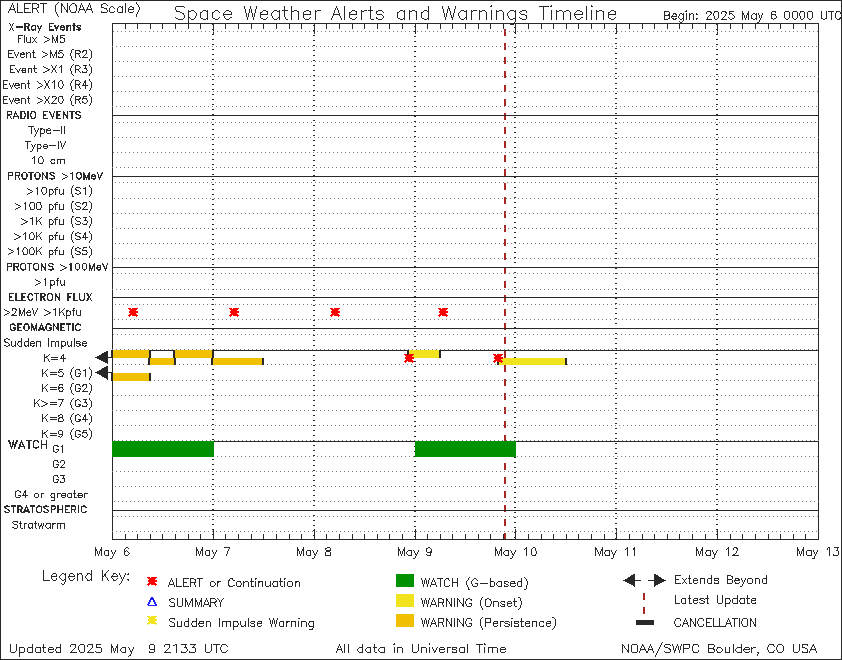
Space Weather Alerts (NOAA/SWPC Last 12 Hours)
- Loading alerts…
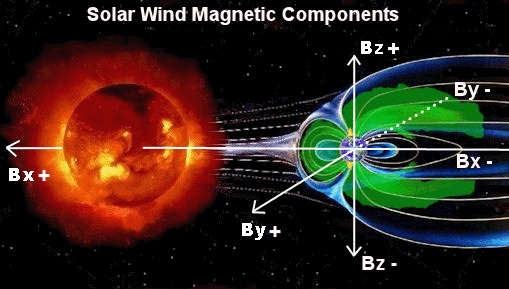
▲ ACE/DISCOVR Solar Wind Bx, By and Bz Components (last 24 hours)


▲ The D-Region Absorption Product addresses the operational impact of the solar X-ray flux and SEP events on HF radio communication. Long-range communications using high frequency (HF) radio waves (3 – 30 MHz) depend on reflection of the signals in the ionosphere. Radio waves are typically reflected near the peak of the F2 layer (~300 km altitude), but along the path to the F2 peak and back the radio wave signal suffers attenuation due to absorption by the intervening ionosphere. The model is used as guidance to understand the HF radio degradation and blackouts this can cause. The SWPC page includes an animated version of the map.
GOES Magnetometers (Last 6 Hours)
▲ NOAA SWPC ENLIL Solar Wind Model
▲ ESA European Solar Wind Model (https://swe.ssa.esa.int/)
Near-Earth solar wind forecast (EUHFORIA)
▲ Kyoto Realtime Auroral Electrojet AE-Index (current day)
▲ Kyoto Disturbance Storm Index (current month)
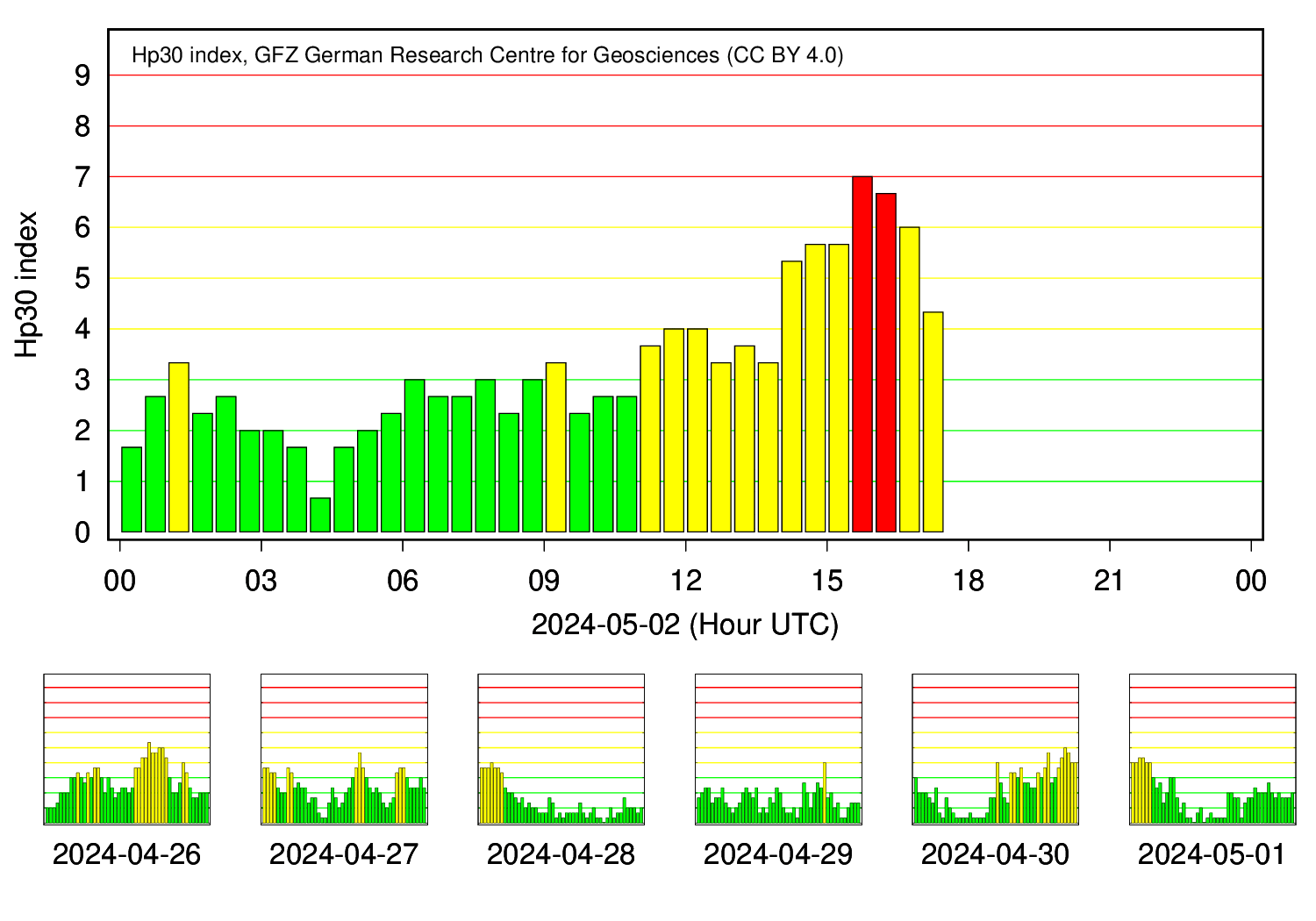
-Link to Auroral Electrojet Index Realtime "Quick look" (Kyoto, Japan)
http://wdc.kugi.kyoto-u.ac.jp/ae_realtime/today/today.html
Satellite solar wind data
ACE Satellite at L1 - gives up to 50 minutes' warning of an event at Earth.
Bz = solar wind magnetic polarity (negative/south is good for aurora).
Sharp density and speed increases indicate possible CME incoming to Earth.
A solar proton event (SPE), or "proton storm", occurs when particles (mostly protons) emitted by the Sun become accelerated either close to the Sun during a flare or in interplanetary space by CME shocks. The events can include other nuclei such as helium ions and HZE ions. These particles cause multiple effects. They can penetrate the Earth's magnetic field and cause ionization in the ionosphere. The effect is similar to auroral events, except that protons rather than electrons are involved. Energetic protons are a significant radiation hazard to spacecraft and astronauts.
A geomagnetic storm (commonly referred to as a solar storm) is a temporary disturbance of the Earth's magnetosphere caused by a solar wind shock wave and/or cloud of magnetic field that interacts with the Earth's magnetic field. The increase in the solar wind pressure initially compresses the magnetosphere. The solar wind's magnetic field interacts with the Earth's magnetic field and transfers an increased energy into the magnetosphere. Both interactions cause an increase in plasma movement through the magnetosphere (driven by increased electric fields inside the magnetosphere) and an increase in electric current in the magnetosphere and ionosphere.


Live data from BGS: Link
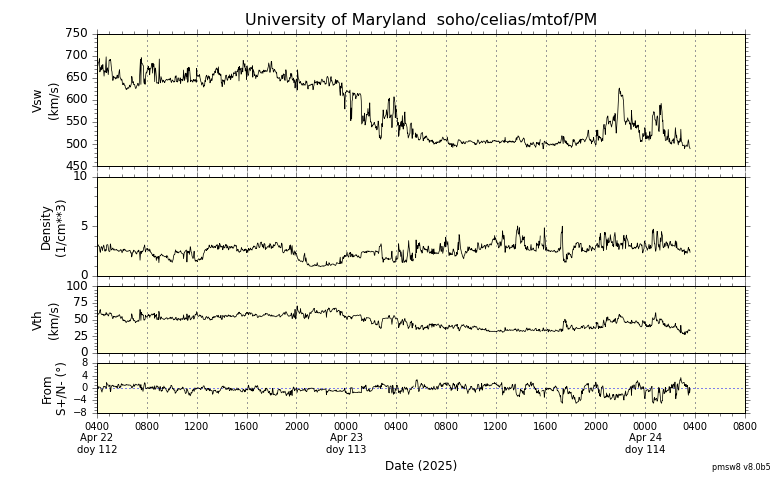
▲ SOHO latest solar wind data
The page is refreshed once per five minutes.